
Lean Startup Services with Agile MVP Development
Every successful startup begins with an idea. Some ideas remain dreams, while others become scalable businesses that transform industries. Between these two stages lies the most critical challenge for founders: building the right product, at the right speed, with the right execution strategy.
This is where Agile MVP development becomes essential.
At SmallDay, startups are empowered to move from concept to market rapidly through lean engineering practices, agile execution, and continuous product evolution. The focus is not simply on software development, but on helping founders validate ideas, achieve product-market fit, and prepare products for long-term scalability.
Why Agile MVP Development Matters
For startups, speed and adaptability are often more important than perfection in the early stages.
Requirements evolve continuously after launch. Customer expectations change rapidly. Market feedback reveals new opportunities and exposes weak assumptions. Traditional development models struggle in such dynamic environments because they depend heavily on fixed documentation, rigid planning, and long release cycles.
Lean startup methodology solves this problem by focusing on:
- Rapid MVP launches
- Continuous iteration
- Customer feedback-driven development
- Faster experimentation
- Reduced waste in engineering efforts
An MVP (Minimum Viable Product) allows startups to validate their core business idea with real users before investing heavily in large-scale product development.
How SmallDay Supports Startup Development
SmallDay is uniquely positioned to address startup engineering challenges through an agile-first development approach.
The development model is designed specifically for startups where:
- Requirements continuously evolve
- MVP launch timelines are aggressive
- Documentation may initially be limited
- Business priorities shift rapidly
- Speed of execution is critical
- Early customer feedback drives product decisions
The primary goal is to validate the product idea quickly while maintaining engineering discipline and minimizing unnecessary complexity.
Key startup-focused engineering principles include:
- Faster MVP delivery cycles
- Agile sprint-based execution
- Open-source technology adoption
- Continuous integration and deployment
- Early analytics integration
- Technical debt visibility
- Incremental scalability planning
Phase 1: Initiation and MVP Development
The first phase focuses on transforming the startup vision into a functional MVP that can be launched quickly and tested in the market.
Requirement Prioritization
The MVP roadmap begins by identifying features with the highest business impact and fastest validation potential. Features are prioritized based on:
- User value
- Revenue potential
- Market differentiation
- Ease of implementation
- Validation importance
These requirements are organized and tracked using agile project management tools such as:
- JIRA
- Rally
- VersionOne
Founder and Development Alignment
A successful MVP requires deep collaboration between founders and the engineering team.
During the initial planning stage, discussions focus on:
- Product vision
- Business objectives
- User journey
- Customer pain points
- Technical feasibility
- Delivery priorities
This ensures the engineering team fully understands not just what needs to be built, but why it matters.
Agile Communication Framework
To maintain execution speed and avoid confusion, communication structures are finalized early, including:
- Single point of contact
- Sprint duration (1–3 weeks)
- Reporting frequency
- Collaboration channels
- Sprint review process
- Backlog management workflow
This creates operational clarity across all stakeholders.
Engineering Best Practices
Lean MVP development does not mean compromising engineering quality. Strong engineering practices are implemented from the beginning, including:
Modern Development Tools
Using high-productivity IDEs and development environments such as:
- IntelliJ IDEA
- Visual Studio
- Android Studio
- PHPStorm
- Eclipse
Continuous Integration
CI pipelines are implemented using tools like:
- Jenkins
- CircleCI
This minimizes integration issues and accelerates release cycles.
Analytics Integration
Analytics are deployed from the earliest MVP version to track user behavior and product engagement using platforms like:
- Google Analytics
- Flurry
- Kissmetrics
This enables data-driven product decisions immediately after launch.
Peer Code Reviews
Code reviews improve:
- Code quality
- Maintainability
- Knowledge sharing
- Defect reduction
Technical Debt Identification
Rapid development can introduce shortcuts. Early identification of technical debt helps startups plan future scalability improvements without slowing MVP delivery.
MVP Development Philosophy
The focus during this phase remains clear:
- Avoid unnecessary complexity
- Prevent requirement changes during active sprints
- Prioritize high-impact functionality
- Launch as early as possible
Typical Duration
2 to 4 months
Phase 2: Achieving Product-Market Fit
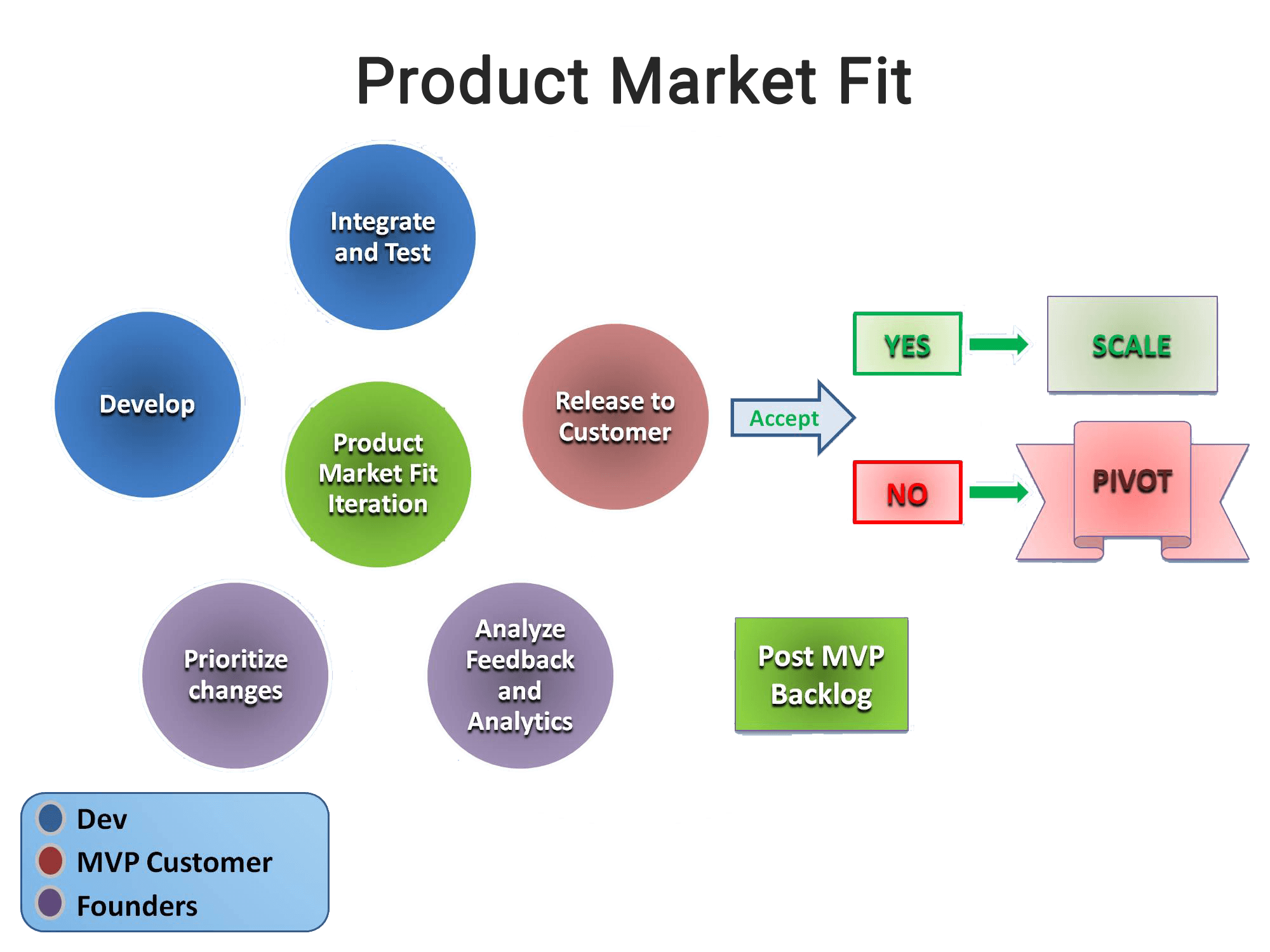
This phase is centered around achieving product-market fit.
Defining Product-Market Fit Metrics
Founders define measurable KPIs such as:
- User retention
- Active users
- Conversion rates
- Revenue growth
- Customer engagement
- Feature adoption
These metrics help determine whether the product is gaining meaningful traction.
Feedback-Driven Product Evolution
Continuous feedback analysis becomes a daily process.
Startups analyze:
- User behavior analytics
- Customer feedback
- Feature usage trends
- Support requests
- Churn patterns
Based on this analysis:
- High-value features are enhanced
- Low-value items are removed
- New opportunities are prioritized
Faster Release Cycles
As market learning accelerates, sprint durations may be reduced to one week or less.
This is supported through:
- Continuous Integration
- Test Automation
- Continuous Delivery pipelines
The objective is to release updates, improvements, and fixes rapidly until strong product-market fit is achieved.
Scalability and Technical Evaluation
As user adoption grows, engineering assessments focus on:
- Scalability bottlenecks
- Infrastructure readiness
- Performance optimization
- System reliability
- Technical debt remediation
DevOps Culture
A strong DevOps mindset becomes essential during this phase.
Ideally:
- 30% or more of the team contributes to DevOps responsibilities
- Deployment automation becomes standard
- Monitoring and operational ownership are shared across teams
Typical Duration
6 to 12 months
Phase 3: Scaling the Product
Once product-market fit is achieved, the focus shifts toward scaling the platform for growth, reliability, and enterprise readiness.
Scalability Engineering
Engineering priorities now include:
- High availability architecture
- Load optimization
- Database scaling
- Infrastructure resilience
- Distributed system optimization
Performance Engineering
Comprehensive performance engineering activities include:
- Static analysis
- Dynamic analysis
- Benchmark testing
- Scalability audits
- Performance remediation
This ensures the platform can handle increasing traffic and operational demands.
Security and Reliability
As the user base expands, stronger security controls become mandatory, including:
- Infrastructure hardening
- Application security improvements
- Access control management
- Vulnerability assessments
- Compliance readiness
Continuous Delivery and Monitoring
Continuous Delivery evolves into a mature operational system supported by:
- Automated deployments
- Real-time monitoring
- Incident alerting
- Infrastructure observability
- Operational dashboards
Disaster Recovery and Business Continuity
Scalable businesses require operational resilience.
Key areas include:
- Disaster Recovery (DR)
- Backup strategies
- Failover planning
- Business continuity management
These systems ensure product availability even during infrastructure or operational failures.
Building Startups the Lean Way
Startups succeed when they can learn faster than competitors.
Lean startup engineering combined with Agile MVP development enables founders to:
- Validate ideas quickly
- Reduce development risk
- Adapt to market feedback
- Launch faster
- Optimize product direction
- Scale sustainably

